
Maintain / Ongoing care
Your website needs
a plan after launch.
Keep updates, backups, monitoring and technical help organised through a defined maintenance agreement. The plan should match how the site operates and what interruption would mean for the business.
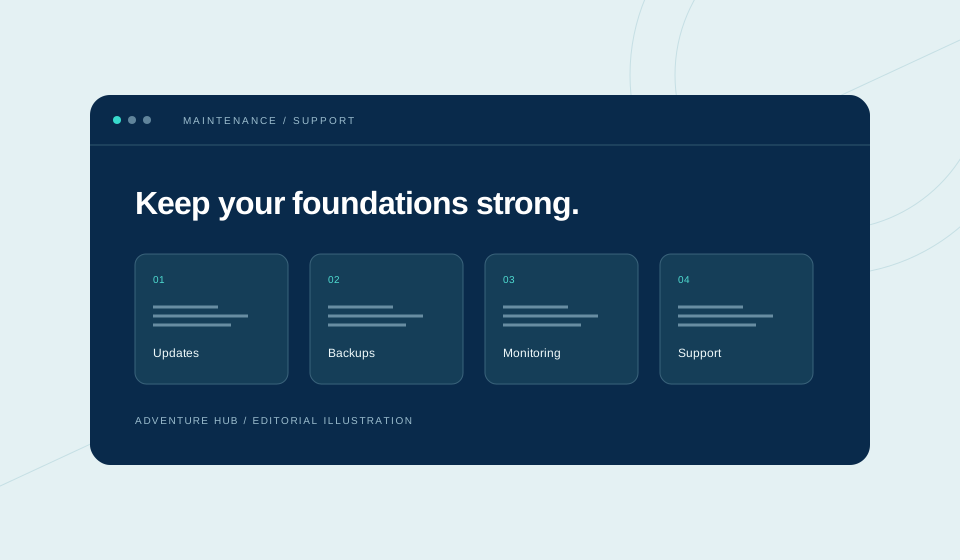
Continuity is an ongoing responsibility.
A website combines WordPress, extensions, hosting and external services. Each can change. Maintenance establishes who checks what, where backups are kept, how an issue is reported and what happens when restoration is needed. It reduces avoidable risk without promising that incidents cannot happen.
A defined project, not an open-ended promise
Monthly and annual agreements are available by proposal. Hosting, premium licences, emergency work, content entry and new features are included only where stated. There is no implicit 24/7 service, unlimited development or guaranteed recovery time.
Scope of work
What we can work on together.
The final proposal states the selected activities, delivery boundaries and responsibilities.
01
Planned updates
Review WordPress, theme and extension updates. Schedule compatibility-sensitive changes and define when a separate working copy is needed.
02
Backup and restoration
Agree files and database coverage, frequency, retention, storage and restoration responsibilities. A backup should support a usable recovery plan.
03
Security basics
Account access, supported software and appropriate configuration. No plan can guarantee absolute security or replace hosting responsibilities.
04
Monitoring
Define the availability checks, alerts and review cadence included. A monitoring alert and a support response are separate commitments.
05
Corrections and support
A named request route, an agreed allowance and a process for work beyond it. State response targets separately from resolution time.
06
WooCommerce care
Consider orders, checkout and integrations when planning maintenance. New transactions and restoration windows need particular care.
The process
A practical sequence.
Review useful decisions at each stage and keep the work connected to the business need.
Inventory
Record the site, dependencies, accounts and responsibilities.
Agree
Define coverage, cadence, support allowance and escalation.
Maintain
Carry out scheduled work and record material changes.
Review
Report activity and adapt the plan when the site changes.
What we need to get started.
- The site and its operational importance
- Authorised access through an agreed process
- Existing hosting and backup arrangements
- Business hours, contact route and escalation owner
Care for the whole booking journey.
A Reservum project can include ongoing website care. Any product-specific compatibility work or operational checks are defined explicitly in that agreement.
Before we start
Questions worth asking.
Find practical answers on scope, timing, responsibilities and what can be measured.
How do I request a quotation?
Use the short enquiry form on the relevant service page or email info@advhub.co. Provide your email, an optional website address and a short description of what you want to improve. The service and language come from the page. Do not send passwords, payment details or customer records. We clarify requirements and deliverables before proposing work. A successful website message means acceptance by the email service, not verified delivery to the inbox.
What happens after a Reservum demo?
The useful outcome is a shared record of what matches your operation and what still needs clarification. We can then separate the available booking configuration, website work, integrations and optional support in a proposal. If a requirement was not demonstrated, it should remain an open point rather than becoming an assumed commitment. You can review the scope before deciding whether to proceed. A demonstration request does not authorise changes to your site, a purchase, a subscription or activation of real payments.
How do ongoing support agreements work?
A support agreement defines the website covered, included activities, contact route and service hours. It also explains how work is prioritised, what response targets mean and how additional requests are approved. Monthly and annual arrangements can be discussed according to the agreed scope; no public price is assumed here. Access, backup ownership and recovery responsibilities should be documented before support begins. Planned updates, urgent incident work and new feature development are different commitments, so the contract should make their treatment easy to understand.
Your next chapter
Let’s define the right scope.
Describe your starting point and priorities. We will turn them into a proposal with clear deliverables.